Felt
The floor manager for your home game, so the host gets to actually play in it.

What you get
- A blind clock the whole room sharesCast it to the TV and put it on every phone. One number, derived from the same instant, so nothing drifts out of step.
- It says the blinds out loudA one-minute warning, then the new level announced through the speaker. You never have to look up mid-hand.
- Stacks from the box on your shelfTell it which chips you own. It hands back the exact pile to count into each stack, and never more of a colour than you have.
- Blind structures built to fit your nightSay how long it should last. It builds a schedule from your stacks, snapped to blinds a person would say out loud.
- Colour-ups planned in advanceIt works out when each denomination stops being money and hangs the instruction on a break, smallest chip first.
- Payouts that add up to the tin exactlyRounded onto whole dollars or fives and still equal to the money you are holding. Never four dollars adrift.
- One-tap rebuys, add-ons and knockoutsFinishing places are worked out for you, bounties paid automatically, and everything undoes.
- A live cash-game ledgerWho is in for what, top-ups as they happen, and the pizza somebody paid for folded in.
- Settle up in the fewest paymentsExact pairs first, then biggest owes biggest — so four people hand over money twice instead of six times.
- It tells you when the count is offIf the chips do not add up to the money that went in, Felt says so and by how much instead of hiding it in the last person.
- A six-character code, no accountsPlayers watch the clock, the standings and their own profit and loss. No sign-up, no download, no app store.
- Big screen modeFull screen, screen-lock defeated, readable from a sofa across a dim room.
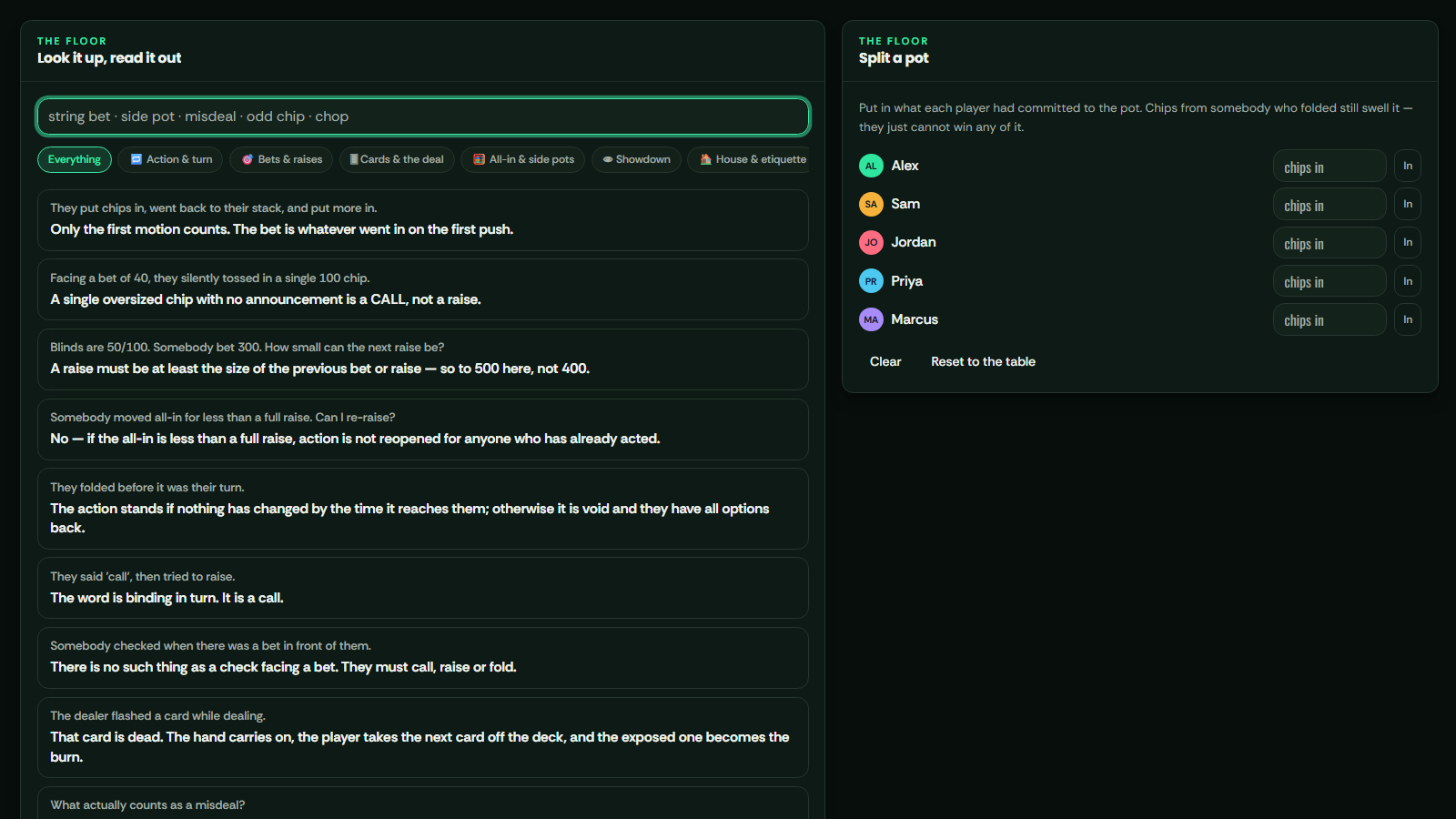
- A floor to callTwo dozen plain-language rulings written to be read aloud — string bets, misdeals, the odd chip, who shows first.
- A side-pot splitterThree players all-in for three different amounts. It says which pots exist and who can win each one.
- The LeagueEvery night you have saved, added up: profit, form, streaks, wins and average finish — by person, not by however their name got typed.
- Print the nightOne page: the ledger, the prizes and the settle-up sheet, with tick boxes.
Is this for you?
- You own the chipswhich means you also own the arithmetic, and you have not properly played in your own game for months.
- Your blinds go up when someone noticesbecause the clock is a kitchen timer on somebody's phone, face down under a drink.
- Somebody always goes home shortand nobody can work out where the five dollars went.
- You run a cash game on trustand the settle-up at 1am is six people doing mental arithmetic while tired.
- Your table argues about rulesand the tie-breaker is currently whoever is loudest or has the fastest phone.
- Same crew, every month, for yearsand not one of you can prove who is actually up over all that time.
Free to use — upgrade for more
Felt remembers every night you have ever hosted, and the season grows with them.
$5/mo
- Unlimited saved game nights — free keeps your last five
- A season that keeps growing: The League reads every night you have ever saved
- Save as many blind structures and chip sets as you own
- Print or save a night as a one-page ledger
About Felt
The host never gets to play
Somebody at your table owns the chips, and that person spends the night doing sums. Counting stacks before anyone arrives. Working out what the blinds should be. Remembering that Dave rebought. Doing percentages on a phone while five people wait to find out what second place gets. Then, at one in the morning, standing at the table with a pen trying to make everyone square. None of that is poker. It is admin, and it lands on the one person who was most looking forward to the evening. Felt is that job, done — so the person who owns the chips gets to be a player again.
It starts from the box on your shelf
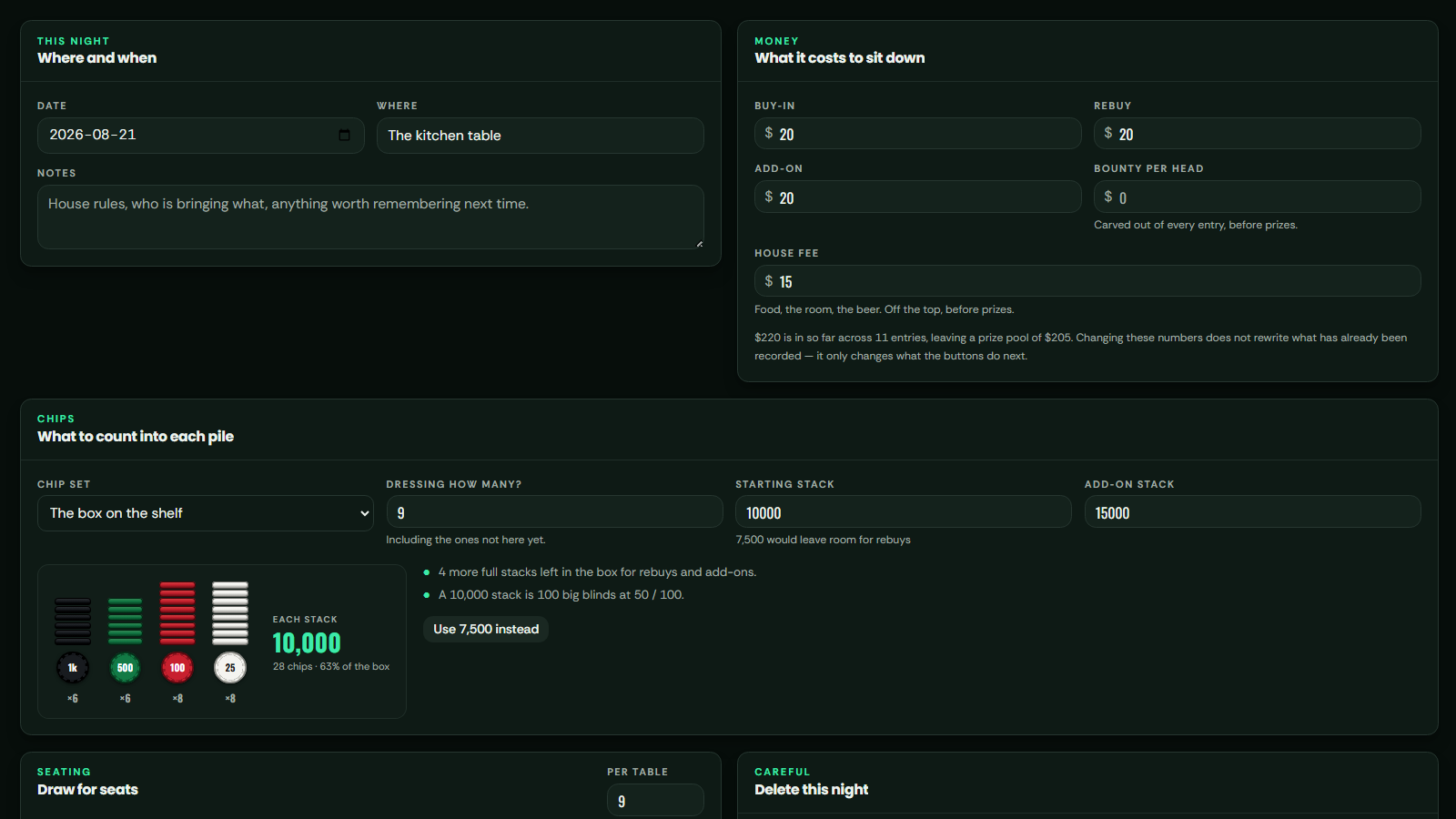
Every other chip calculator asks what starting stack you want and tells you what it adds up to. That is the wrong question. The real one is what do I count into nine piles from this box, and the answer depends on what is actually in it. Tell Felt your denominations and how many of each. It deals the small chips first, because a stack that is mathematically ten thousand but holds two whites cannot post a blind three times. It never hands out more of a colour than you own. And it tells you how many rebuys are left in the box, because a home game runs out of chips at the first rebuy far more often than it runs out at the start.
One tap, and it works out the rest
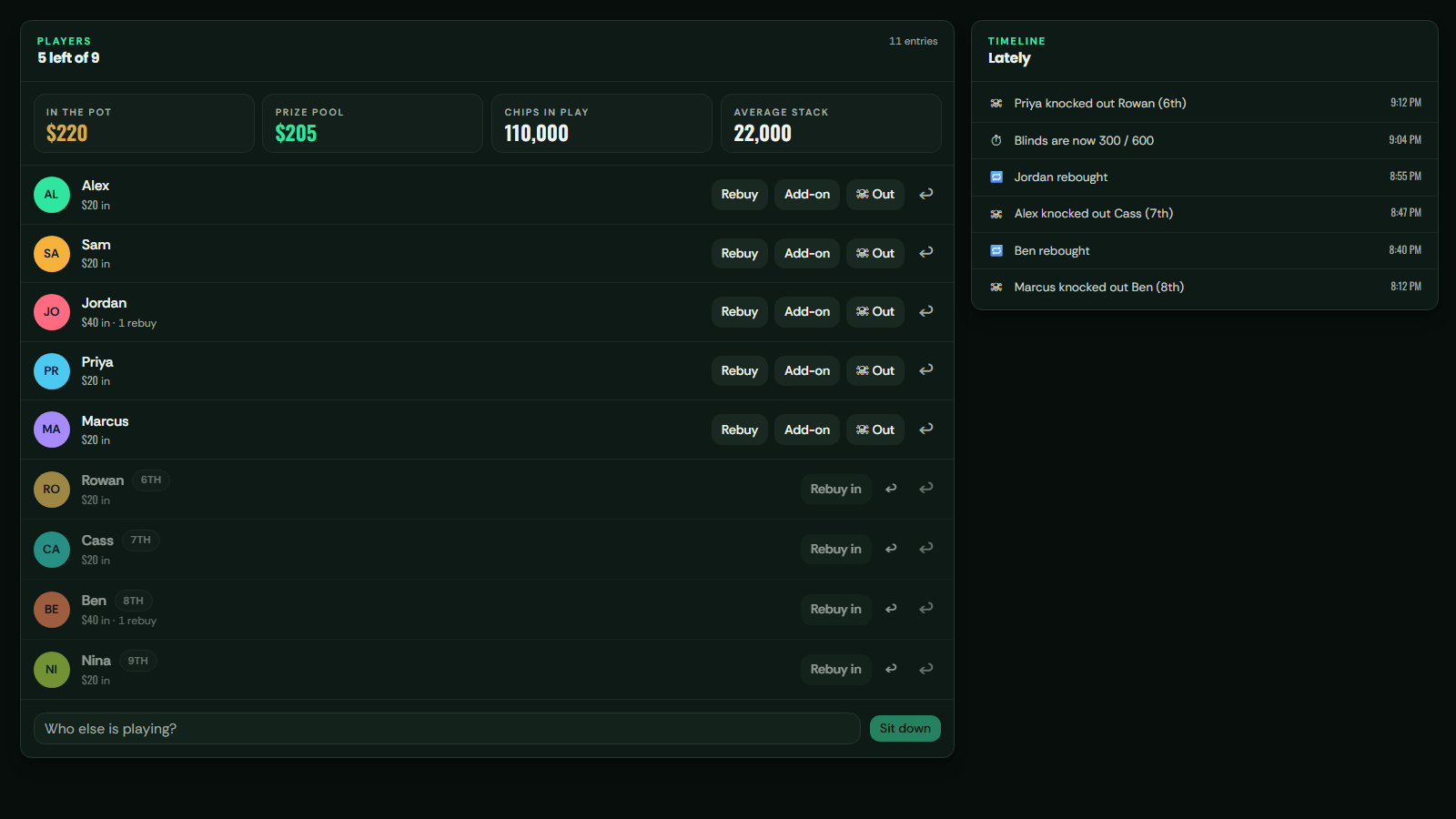
Rebuy, add-on, knocked out. That is the whole interaction budget for somebody holding cards at midnight with three people talking to them, so that is the whole interface. Knock a player out and Felt works out their finishing place from how many are left — which keeps the places contiguous when three people bust inside a minute, exactly when a host is least able to keep track. It asks who did it, because that is what a bounty is paid on, but nobody in particular is the first option and it is one tap. Nothing here asks you to confirm, and everything here undoes.
The prizes add up to what is in the tin
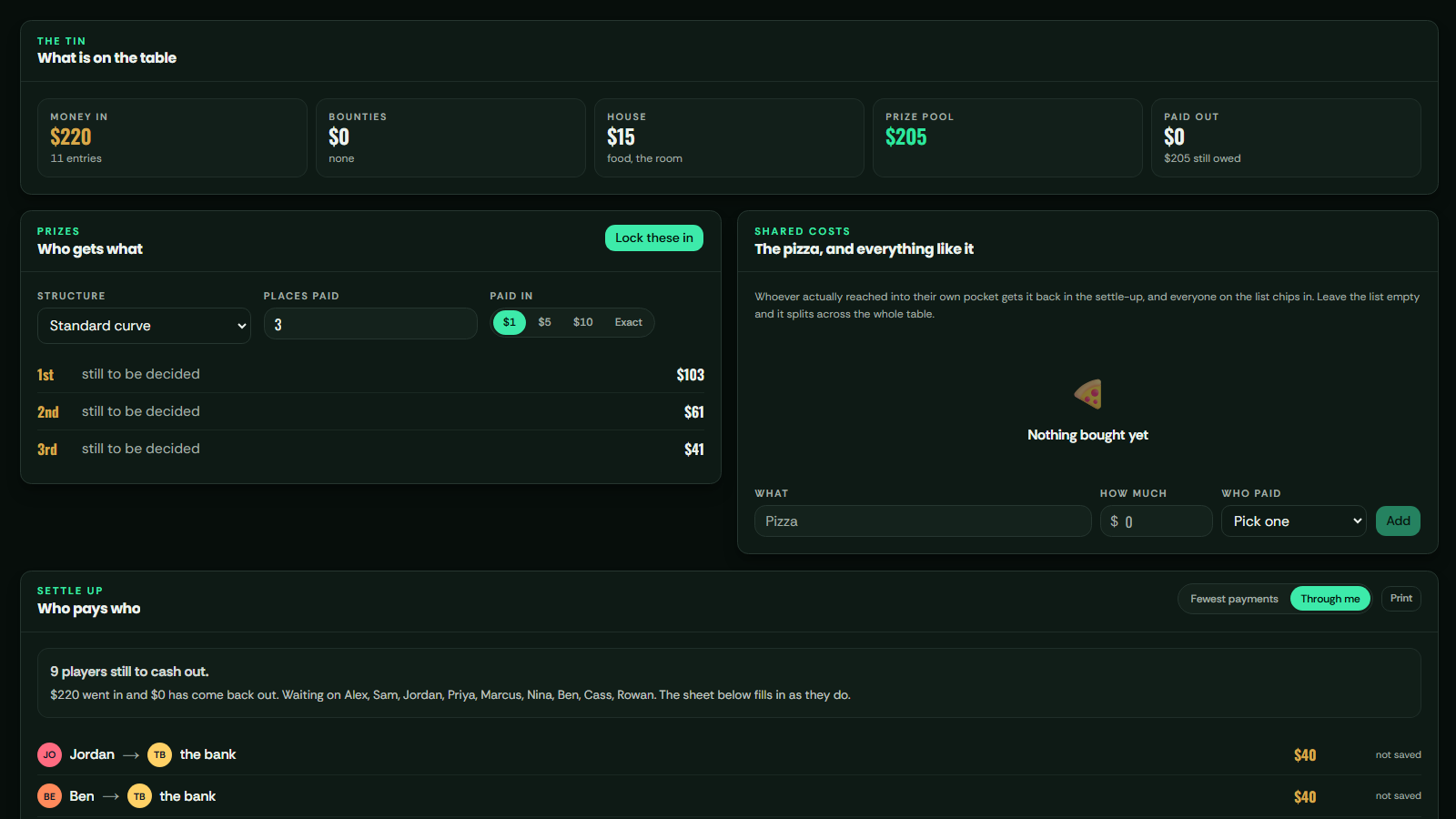
Fifty, thirty and twenty percent of two hundred and five dollars is 102.50, 61.50 and 41. Nobody has a fifty-cent piece, so somebody rounds — and rounding three numbers independently is how a table ends up four dollars short with everyone certain they did it right. Felt rounds onto whatever you actually pay in, whole dollars or fives, and then hands the leftover back to the places that lost the most to the rounding. The lines always sum to the pool exactly. That is not a goal, it is an invariant: the test suite checks it across four thousand generated structures, every mode and every increment.
And when the count is off, it says so
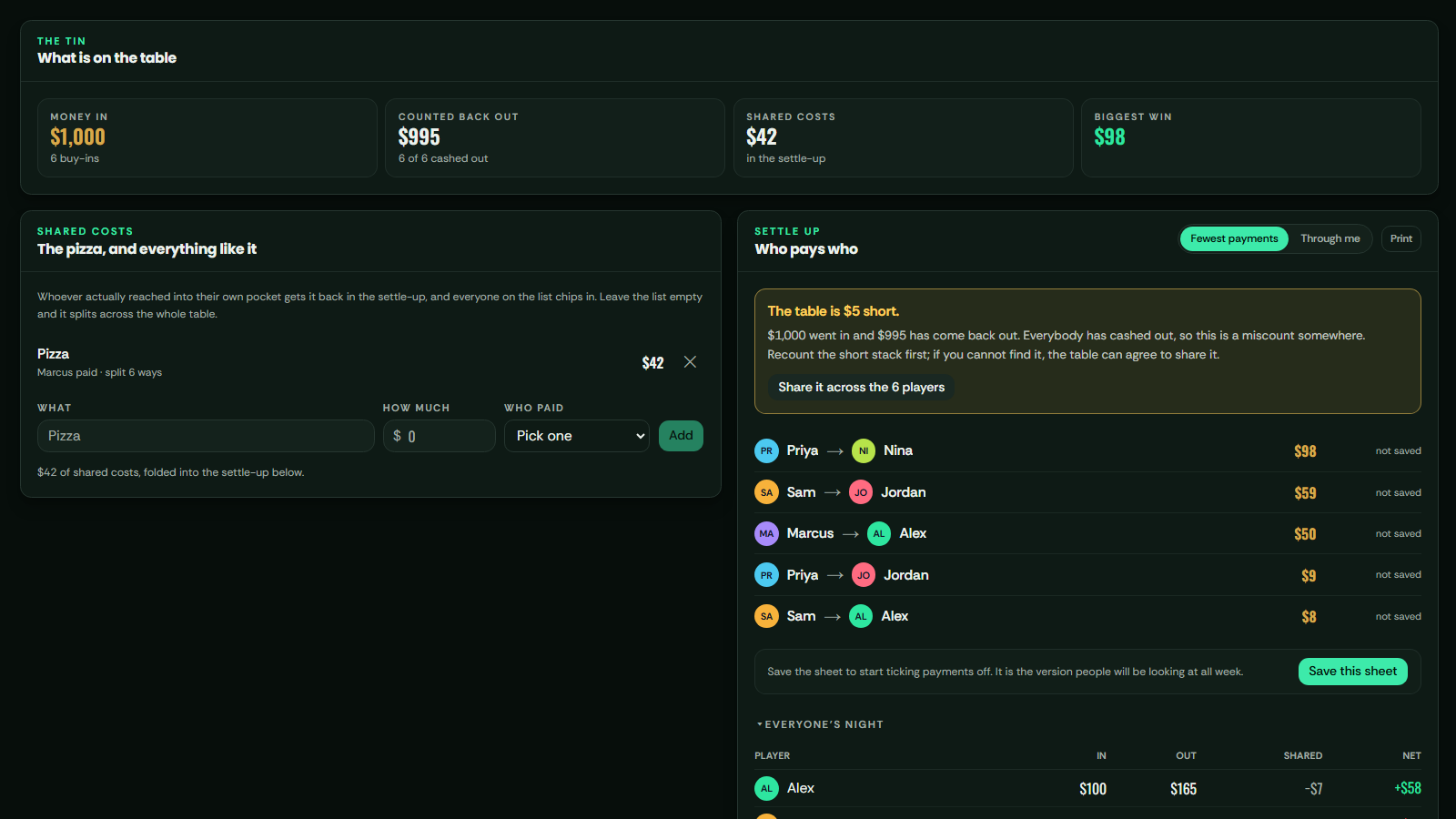
At the end of a cash game the chips are supposed to add up to the money that went in. Very often they do not — one rolled under the sofa, somebody took a fiver out for the delivery driver, a stack got counted at forty-seven when it was seventy-four. Every other settle-up tool absorbs that difference into whoever happens to be last in the loop, and one person goes home short without ever finding out why. Felt puts it in words, above the transfers, before proposing any of them: the table is five dollars short. Then it offers the two honest options — go and find it, or agree to share it, which writes a visible adjustment against each player rather than a silent nudge.
A kitchen table has no floor
In a card room you shout Floor and somebody with authority walks over, makes a call, and the hand carries on. At home you get six friends, one of whom is now reading three contradictory forum threads out loud while the pot goes cold. So Felt ships the floor. Two dozen rulings for the arguments that actually happen — string bets, the single oversized chip, a flashed card, who shows first, the odd chip in a split — each written to be read aloud: the call in one sentence, the reason in the next, and where houses genuinely differ it says so instead of pretending there is one true answer. Beside it sits a side-pot splitter, because three players all-in for three different amounts is the hardest sum at any home table and the one that gets done wrong most.
Recent updates to Felt
- New
Felt has been rebuilt around the night you are running
The app now has two clear levels. Home is where you start a night and see the ones you have saved; open one and the whole sidebar becomes that night — its name at the top, its clock, players, money, blinds and setup underneath. Starting a night asks tournament or cash game first, on its own, then only asks what that kind of night needs. Your kit is now Settings, where a new "How your nights usually go" section remembers your buy-in, your regulars, your chips and your usual structure. The Floor is now House rules, and the chip box names its columns.
- New
Load a blind structure you saved earlier
Saved schedules now drop straight into a night from the Blinds tab. Before it swaps, Felt tells you which level the clock will land on, so a mid-game change never surprises the table.
Requirements
A browser, and the chips you already own. Players need nothing at all — they open a six-character code on their own phone, with no account and no download. Works on a laptop, a tablet propped against the chip case, or cast to a television.
More like this



Customer reviews
Sign in to write a review.