What you get
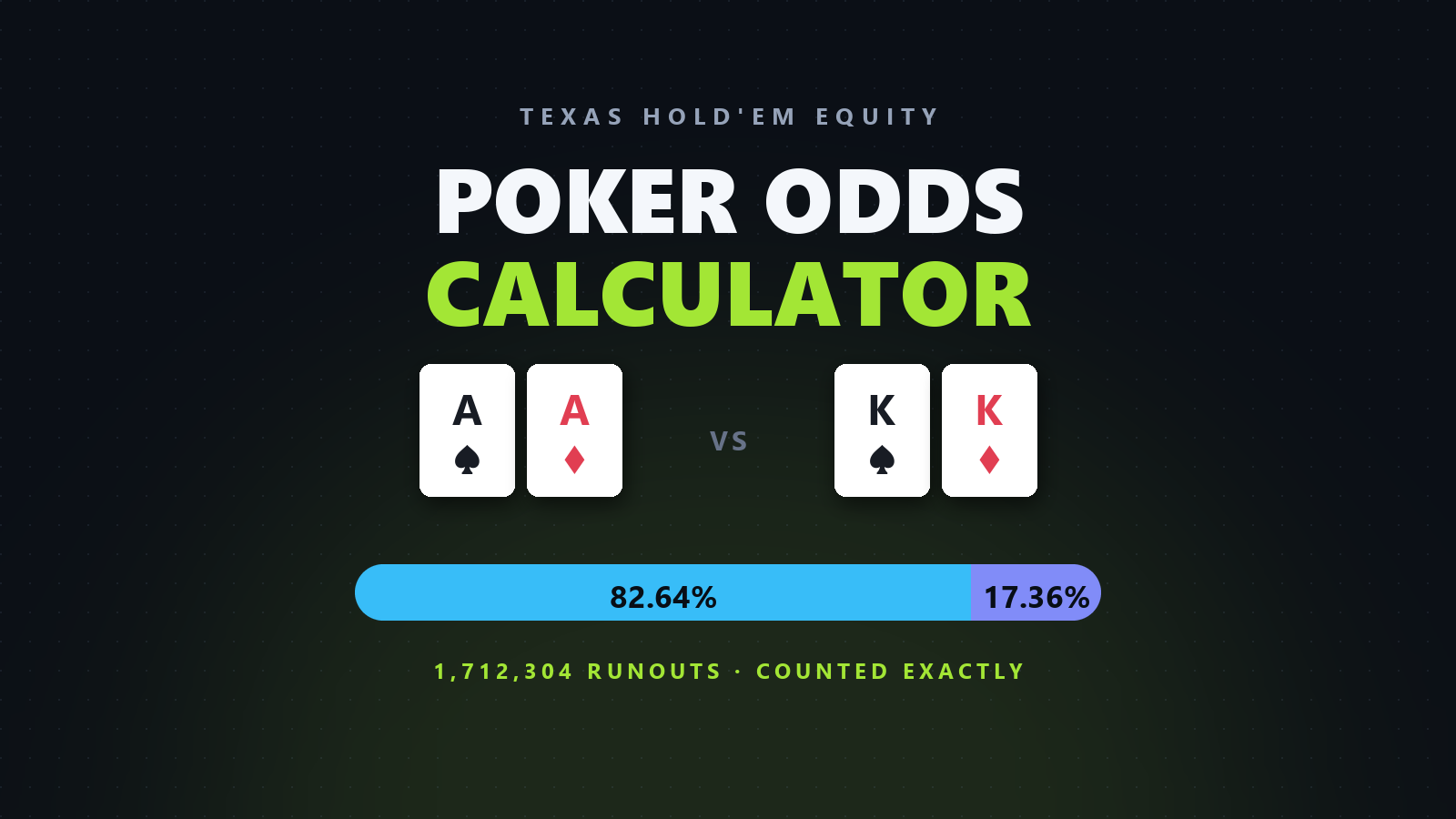
- Counted, not sampledEvery runout is played out and tallied — 1,712,304 of them before the flop. The panel says how many, so you can tell exact from estimated.
- Up to nine hands at onceWhere poker intuition fails hardest. Aces are 85% against one hand and 35% against eight, and nothing in your head gets you between those.
- One tap per card, and the cursor moves itselfThe whole deck stays on screen. Tap a card, it lands in the lit slot, the slot advances. Or type it: press a rank, then a suit.
- A chair can hold an unknown handNot the same as an empty chair. An unknown player takes two cards out of the deck, can win the pot, and pulls everyone else down.
- Deal the board, or place it card by cardPut out the flop you were shown, or take a random one. Streets deal together — equity after one card of a flop is a hand that never was.
- Win, chop and equity are three different numbersA three-way chop pays a third, not a half. All three are on screen, because the one people quote is not the one to decide with.
- How often each seat makes each handA matrix from straight flush down to high card. This is where "why am I only 35%" usually turns out to have an answer.
- The address bar is the save fileEvery card you place rewrites the URL, so a bookmark or a pasted link reopens the exact table — no account, no saving, nothing stored.
- It never phones homeThe arithmetic runs on your own machine, in a background thread so the page never stalls. Your hands are not sent anywhere at all.
- Built for the phone in your hand at the tableThe full deck still fits at 400 pixels wide, and the nine-seat ring folds into a column rather than shrinking into something you cannot tap.
Is this for you?
- You just got it inYou want to know whether you were right. Thirty seconds, seven taps, an exact number — and the distribution that explains it.
- Your calculator is fifteen years oldIt works. It also samples, cannot be linked to, and was not built for a phone.
- There is an argument in the group chatSet the spot up, copy the link, and let the other person open the same table rather than the same argument.
- You are studying, not just checkingThe hands-made matrix turns "I am 35%" into "I make a flush one time in three and it is good almost every time".
- You run the home gameSettle the bad-beat story at the table, on the phone that is already in your hand.
- You will not sign up for a percentageThere is not one. Nothing is stored and nothing is sent — the public page needs no sign-in at all.
About Poker Odds Calculator
Most free odds calculators guess. They deal a few thousand random hands, average the results and print a percentage with no way for you to tell a good estimate from a wrong one. This one counts. When every hand is known there is nothing to sample — the whole space of runouts is small enough to play out in full, so it plays out all of it: 1,712,304 boards for two hands before the flop, 990 on the flop, 44 on the turn. The panel under the board always tells you how many hands were played out and whether that was all of them, and it says "sampled" just as plainly on the one case it cannot count — an opponent whose cards you have not entered. Tap a card from the deck and it lands in the highlighted slot, then the highlight moves on by itself, so a heads-up spot with a flop is seven taps and no mode switching. Seat up to nine players, mark any chair as an unknown hand, deal a street at random or run the board out. Under the table you get the pot cut into each player's share, win against chop against equity, and a matrix of how often every seat finishes with each kind of hand — which is where the reason behind a number usually is. Nothing is stored and nothing is sent anywhere: the maths runs in your browser and the spot you are looking at lives in the address bar, so a bookmark or a pasted link reopens exactly the table you were staring at.
Requirements
Any modern browser. Nothing to install, no account needed for the public version at /poker-odds-calculator.
More like this




Customer reviews
Sign in to write a review.